01
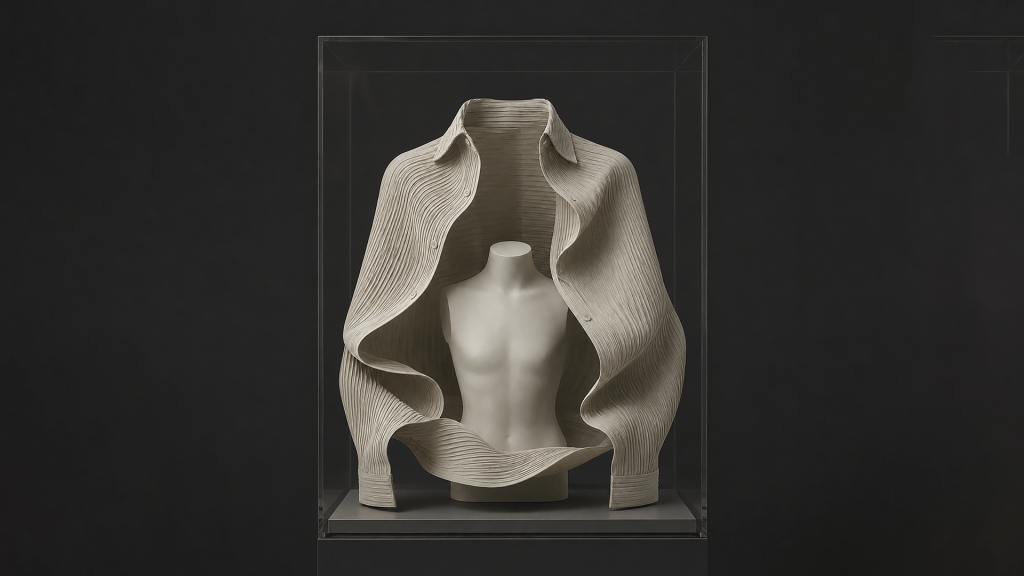
At first, Miyake’s pleats can seem
like costly wrinkles on loose clothes.
They reject fitted luxury silhouettes
and keep a distance from the body.
But that distance holds a question.
02
For Miyake, clothing was not merely
a decorative shell around the body.
He began with one piece of fabric
and studied how it folded and moved.
Clothes should free, not fix, the body.
03
In late-1960s Paris, Miyake witnessed
distrust of authority and hierarchy.
Yet fashion still served a wealthy few,
fixed body types, and narrow ideals.
He began to question that entire system.
04
Why should beauty belong to a few?
Why must fine clothes feel restrictive?
His answer was clothing for the many:
not cheap clothing, but inclusive forms
for more bodies, lives, and movements.
05
His pleats were never mere decoration.
They changed how each garment behaved.
The clothes packed flat, opened easily,
responded to motion, and resisted wear.
Pleats became a practical mechanism.
06
Conventional luxury disciplines bodies.
Straight shoulders and a narrow waist.
Miyake’s clothes let the body relax.
They expand while walking, sitting,
or reaching, and come alive in motion.
07
His work joined fashion with sculpture,
architecture, engineering, and movement.
He asked how flat cloth could become
a three-dimensional form on the body.
Technology served comfort and freedom.
08
Miyake proved philosophy can be product.
But ideas must become something people
can touch, wear, and experience.
His pleats carried one consistent logic:
artistic, practical, and humane design.
09
A strong brand sells a way of seeing.
Difference lasts when it has a reason.
Miyake’s unusual forms changed how
people felt and moved inside clothing.
That is how pleats became his language.
10
His work asked whether beauty must bind,
exclude, discomfort, or limit the body.
The pleat was not his final legacy.
He changed how we see clothes, bodies,
and the freedom design makes possible.
2027_01_06
 worldwiseclub
Leave a comment