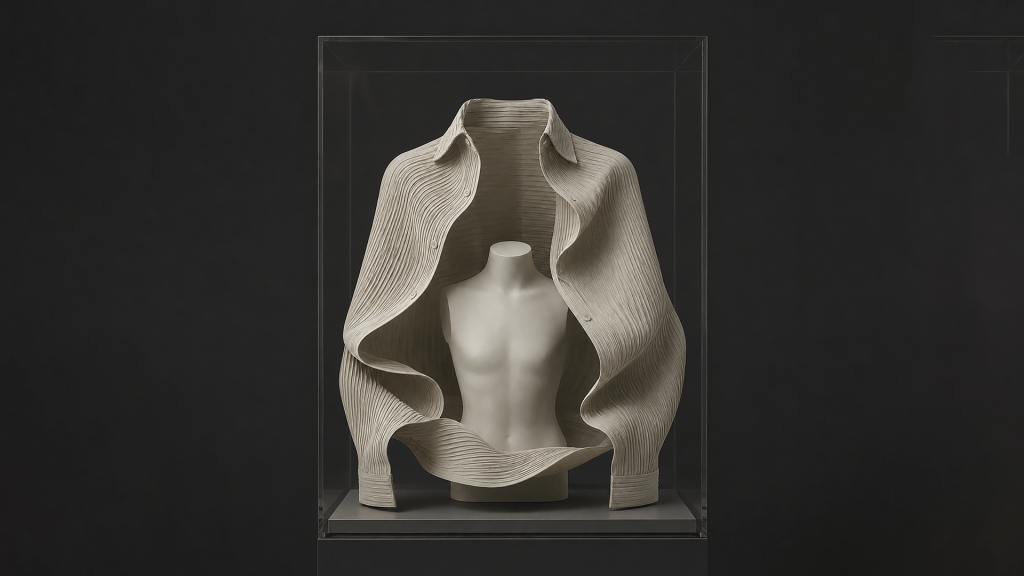
[The Question Hidden Behind the Pleats]
When people first encounter Issey Miyake’s clothes, many have the same reaction.
Why are these wrinkled-looking clothes so expensive?
At first glance, they may seem like little more than heavily pleated garments: unusual in appearance, loose on the body, and uninterested in flattering the figure in a conventional way. After all, luxury fashion is usually associated with precise tailoring, sharply defined silhouettes, close-fitting structures, and the tactile richness of expensive materials.
By those standards, Miyake’s clothes can feel unfamiliar. Rather than clinging to the body, they maintain a certain distance from it. Their form changes more dramatically in motion than at rest. Folded, they become flat; unfolded, they expand into three-dimensional shapes. They may look simple on the surface, but a closer look reveals how carefully they calculate the space between fabric and body.
To understand Miyake’s design philosophy, we must first move beyond the idea that clothing is merely a decorative shell for the body. For him, clothes were not devices designed to hold the body in place. They were closer to structures that allowed it to move more freely.
One of the central ideas he explored throughout his life was “a piece of cloth.” Rather than beginning with a finished category such as a jacket, dress, or pair of trousers, he began with a single thread and a single piece of fabric. He observed how that fabric folded, stretched, rested on the body, and transformed through movement. This is where the essence of Miyake’s design lies.
His clothes, then, are not simply objects intended to look beautiful. They are closer to questions about the kind of relationship clothing should have with the human body.
[From Clothing for the Few to Clothing for the Many]
There is an important historical context behind Issey Miyake’s philosophy. He was in Paris in the late 1960s and witnessed the atmosphere surrounding the protests of May 1968.
This does not mean that he saw a political revolution and immediately decided to create clothing for the masses. More precisely, Paris at the time had become a place where deep suspicion toward established authority and elite-centered systems erupted into public view. Students and workers were asking why a small group of powerful people and institutions should determine the direction of society. Resistance to existing hierarchies and authority spread throughout the streets.
And Miyake happened to be standing at the center of the fashion world: Paris.
High fashion in Paris was then dominated by haute couture. Haute couture was beautiful and artistic, but it was also an extremely restricted world. Much of it was designed for a small number of wealthy clients, particular body types, specific social occasions, and a narrowly defined ideal of femininity.
Within that world, Miyake seems to have begun asking questions.
Why should clothing be made only for a select few?
Why should beautiful clothes have to be uncomfortable?
Why should high fashion be designed only for certain bodies and social classes?
This is where his idea of “clothing for the many” emerged. It did not mean producing cheap clothes in large quantities. It meant designing clothes capable of accommodating more bodies, more ways of living, and more kinds of movement.
For Miyake, clothing for the many was not inexpensive clothing, but inclusive clothing. It was clothing that could be worn across differences in age, body shape, gender, and lifestyle. Instead of forcing the body to conform to the garment, the garment would be structured to respond to the body’s movement.
That direction is what made his designs so distinctive.
[Pleats Are Not Decoration, but Freedom]
Pleats are undoubtedly the image most closely associated with Issey Miyake. PLEATS PLEASE, in particular, became the line that brought his name into wider public recognition.
But the important point is that his pleats were never merely decorative. We usually think of pleats as a visual effect added to fabric. Miyake’s pleats, however, functioned more like a mechanism that changed how the garment itself behaved.
His pleated clothes could be folded into a compact shape, making them easy to pack in a suitcase. Once unfolded, they stretched naturally over the body. When the wearer moved, the garment responded. Wrinkles did not make it look damaged or neglected. The clothes were relatively easy to wash and maintain. They could even accommodate a certain degree of change in the wearer’s body.
In this sense, Miyake’s pleats can be understood as a form of freedom. Rather than confining the body within the garment, the garment adapts to the body’s transformations.
Conventional luxury clothing often shapes the body into a prescribed form. The shoulders must remain straight, the waist must appear narrow, and the lines of the garment must not lose their definition. In many cases, the body has to remain tense for the clothes to look beautiful.
Miyake’s clothes, by contrast, allow the body to relax. When the wearer walks, sits, or stretches out an arm, the garment becomes not a fixed sculpture but a moving structure. His clothes are therefore more fully realized on a person in motion than they are hanging motionless on a mannequin.
At this point, Miyake’s design begins to resemble architecture, sculpture, and engineering as much as fashion. He was not simply creating beautiful clothes. He was investigating how flat fabric could become three-dimensional when placed on the body. He used technology not to display technical brilliance for its own sake, but to make clothing more comfortable and liberating for the wearer.
His pleats, then, are not simply wrinkles. They are the result of redesigning the relationship between clothing and the body.
[Strong Brands Sell a Way of Seeing the World]
The greatest lesson we can learn from Issey Miyake and the success of his brand is this:
A philosophy can become a product.
But that philosophy cannot exist only in words. It must be translated into a form that people can touch, wear, and experience for themselves.
Miyake’s brand did not endure simply because pleats gave it a recognizable visual identity. It endured because those pleats contained a consistent logic: clothes that placed fewer restrictions on the body, clothes that accommodated a wider range of figures, clothes that were artistic yet practical, technological yet humane, and clothes built around questions that would outlast fashion trends.
That is the power of a brand.
A strong brand does more than sell attractive products. It sells an attitude that says, “This is how we see the world.” When that attitude is carried consistently through the product’s form, function, feel, price, retail environment, imagery, and language, the brand becomes a culture.
Miyake also demonstrated another important lesson: difference must have a reason.
Being unusual for its own sake rarely lasts. But when a brand can explain why it is different, and when that difference changes the user’s experience, distinctiveness becomes a signature.
That is how pleats that initially looked strange eventually became Miyake’s language.
If we look at Issey Miyake’s clothes and ask only, “Are they beautiful?” we see only half of his world. The more important questions are these:
Must clothing restrict the body?
Must luxury clothing be uncomfortable?
Must beauty depend on a particular body type?
Can technology make people freer?
These questions are what elevate his clothes beyond ordinary fashion products. Miyake’s work was not simply about designing clothing. It was about changing the way we think about clothing itself.
Seen from this perspective, his pleated garments begin to look different. They are no longer merely expensive, wrinkled-looking clothes. They become the results of an experiment: an attempt to place fewer constraints on the body and make room for more people.
Good brands sell products. Better brands sell taste. But the brands that endure sell a way of seeing the world.
What Issey Miyake left behind was not a pleat, but a new perspective on clothing, the body, and freedom.
2027_01_06
 worldwiseclub
Leave a comment